Monday, May 29, 2006

Yep, they're just warring with each other

Allahpundit talks about Civil War on Hot Air, and about how, because there don't seem to be any real villains to fight, so the Marvel superheroes turn on each other instead. He also points to a Scotland Sunday Herald article from 2004 that interviews Mark Millar. And what did Millar have to say?
“I like my stories to mean something and touch on current headlines,” Millar said. “It’s too easy to write stories about Spider-Man kicking the crap out of the Green Goblin.
Really? Then maybe you just shouldn't have written that Marvel Knights story with Spidey kicking the crap out of Gobby using a mailbox!

The following part, however, is downright offensive:
“America’s war against this phantom axis of evil was probably the biggest factor in the election and I felt that, if superheroes really existed, they’d be under enormous pressure to get involved. [Around] 1100 mostly poor, mostly black kids have died out there, so how could someone like Captain America just stay here and fight bank robbers or mad scientists? Superheroes are all about responsibility and doing the right thing so it seemed like a nice, complex situation to throw them into this fight that some of them support and many of them don’t.”
So, is that what he thought then and now? Just how well informed is Millar anyway? This page, which keeps track of casualties in Iraq, gives a readout far different from what he must've thought. Pulling out the race card is no way to voice his opposition to the war against terrorism. (By the way, I wonder where his condemnation is for the Muslim savages who murdered any of the soldiers whose lives were lost. Doesn't sound like he's serious if he can't curse the enemy for their crimes.) Nor is denying the existance of the evil of Islamofascism, as he did back then.

It's a real shame that the same company that put out a Support Our Troops comic book is at the same time insulting them by acting as ungrateful as they do with Civil War. As long as people like Joe Quesada are in power, this is likely to keep on going.

Labels:

Comic book piracy online

Yes, there is such a thing as piracy of comics, just like there is for movies on the internet. The Los Angeles Times talks about it right here.
Since their smashing introduction in the 1930s, comic-book heroes such as Superman and Batman have been fighting evil right and left, keeping cities safe and delighting fans.

But these days they and other stalwarts of the industry are stuck in the grip of a sticky Web that could ensnare even Spider-Man. They face foes that couldn't be imagined 70 years ago: digital pirates.

Digital scanning and sharing of comic books have begun to make a dent in the business, driven by easy-to-use file-sharing tools and a culture in which enthusiasts eagerly pass along their copies to one another.

"No comic sells enough to lose some of the market," said Chris Gage, who has written for DC Comics Inc. and independent publisher Arcana Studio. "If your comic book doesn't sell a certain amount of copies, it can get canceled."

[...]

Estimates for the number of comic books shared online are fuzzy because it is difficult to track specific downloads on so-called peer-to-peer networks.

But an informal Web poll of 4,621 readers from December 2004 to December 2005 by Comic Book Resources, an online magazine, found that more than 30% had downloaded a comic book at least once. Twelve percent said they downloaded comic books regularly.

"Are there downloaders in the tens of thousands? Possibly," said Todd Allen, an independent online media consultant and adjunct professor of e-business at Columbia College Chicago. "Are there millions? Not likely."

It's certainly not as widespread a practice as music file sharing, but the comic-book business is much smaller. Although the top 10 comic books may have runs of 100,000 to 150,000 copies for each monthly issue, even giants such as DC Comics and Marvel Publishing have books that sell about 20,000 to 30,000 copies. And many comics don't even break 5,000 anymore, Allen said.

[...]

Driven by collectors and hard-core fans, the comic-book industry will always have its share of loyal paper-copy readers. Aficionados will continue to head to the comic-book store Wednesday mornings, when new titles go on sale, to leaf through the colorful pages and breathe in the freshly printed ink.

"The collector mind-set says, 'I need the paper issue,' " said Gene Kannenberg Jr., director of ComicsResearch.org, a website devoted to scholarship on comic books and strips.

Still, readership is declining. Comic-book publishers are having a hard time, in particular, catching the attention of younger readers, who either are tuned in to a plethora of other media — video games, movies, music, social networks — or would rather get their fix of the action characters free online.

Shane Coleman, a clerk at Golden Apple Comics on Melrose Avenue in Los Angeles, says he sees few from the high-school-and-younger crowd saunter in. The younger customers who do drop in look mainly for horror stories or the Japanese comics known as manga.

"You tend to see more people my age come in," said Coleman, an avid collector who, at age 30, considers himself somewhat old-school.

For some readers, the waiting-for-Wednesday tradition is waning. "Zero-day comics," as they are referred to when they are available online the same day the paper copy hits store shelves, appeal to a younger generation used to getting news, music and movies instantly.

The piracy may start simply enough.
Yes, maybe it will. But that aside, if there's anything else this does tell, it's that, despite attempts to imply otherwise, readership for pamphlets, if anything, is on the sad decline.

Labels:

Sunday, May 28, 2006

Interview with Barry Windsor-Smith

The artist who worked on Conan, and the X-Men, is interviewed in the Poughkeepsie Journal, in preparation for an exhibition in Kingston, where he's been living for many years (he's a native of Britain and moved to the US later in life). He says:
...I quit reading comics in the mid-1980s. That was the founding time of the still prevalent reign of idiotic and disturbing violence over memorable stories with interesting characters.
I'm not entirely sure, but he may be right there. Violence was on the rise even then, and by now, it certainly can't be disputed that comics have become way too violent.

Labels:

Saturday, May 27, 2006

Interview with artist Jerry DeCaire

The Saginaw News interviews Jerry DeCaire, who began his art career on the Uncanny X-Men almost fifteen years ago. Most interesting:
Part of his hang-up centered on an inability to connect with the X-Men's popular anti-hero, Wolverine, a claw-bearing Clint Eastwood-type.

"I just could not relate to him," deCaire said. "He was rugged with a 5 o'clock shadow, and I was more into the celestial god-like characters like Thor and Dr. Strange."

DeCaire eventually worked with those characters too, illustrating titles such as "The Mighty Thor," "Dr. Strange," "The Punisher," "Nick Fury: Agent of Shield," "Iron Man," and "Conan the Barbarian."
Good heavens! The character some might argue is overrated by today was the hardest part of his job. I'm sure glad he got to work on ones like Thor and Dr. Strange later on, whom he could handle better.

Labels: ,

An example of favoratism and double-standards

Here's an old article from 2004 by Bill Radford of the Colorado Gazette, which may be a Knight-Ridder newspaper, that does something that a couple of press sources on comics seemed to do during the time it was published - it "panned" the Sins Past storyline in Amazing Spider-Man, yet went all the way in favoratism when writing about Identity Crisis. First, Radford says:
The story by J. Michael Straczynski casts a new light on Gwen, who was killed when the Green Goblin tossed her off a bridge in the classic "Amazing Spider-Man" No. 121 in 1973. Gwen, it seems, was drawn to Osborn's strength and magnetism.

But the whole thing just rings false. It's an unwelcome tarnishing of Spider-Man's first great love.
Well, I'm sorry to say, Radford, but, the following rings false too, and certainly cancels out whatever you were trying to say with the above when you first wrote it, bozo:
The past also gets a makeover in "Identity Crisis," a riveting seven-part series from DC Comics ending in December.
Oops! What's that? "Riveting"? Well then, if you think it's riveting Radford, surely that's also what you think about Sins Past, too? I fail to see the logic here. Sorry.
Sue is murdered by an unknown killer in the first issue; the rape, told mainly off-panel, is revealed in flashbacks.

Comic-book readers are used to villains plotting to take over the world. But rape?

"That is a little bit rougher," acknowledges Dan DiDio, vice president and executive editor of DC Comics.

"But we tried to tell that in the most responsible way possible."
And what way would that be? By not giving any female perspective in the miniseries? Sorry, but there too, the article bombs out big time. It's shockingly dishonest, and what MSM journalist Radford did there is also what's known as shilling, or even prostrating himself in a company's efforts to ruin its own comic books.
The story has generated a great deal of controversy -- and DiDio couldn't be happier.

"The last thing I want to do is ever tell a story that is met with general apathy," he says.
Here we go again. It's sales through controversy, and DiDio couldn't give a damn what anyone thought, since all he cares about is that we're willing to pay our hard-earned bucks straight into his wallet.
"Identity Crisis" is part of an effort to give more emotional weight to the heroes of the DC Universe, home to Superman, Batman, the Flash and countless others.

"There's always been certain perceptions about DC characters being a little bit softer," DiDio says. "The DC characters have always been very proactive and very heroic and very set in their ways in how they do business, and we wanted to look at them in a different way."
And after that travesty, that's exactly why I realized that the whole notion that the DC characters ought to be "stronger" instead of "softer" is just plain stupid. I've long since learned that it pays not to be too demanding, which is why I don't ask for DC characters to have a personality at any price, and certainly not if it calls for ruining them in retrospect.

DiDio did indicate though, his stance on superheroics: as he hints in the quoted - and highlighted - text above, the heroism is something he's sadly ungrateful for.

And the Colorado Gazette is just one more MSM newspaper source I hereby disapprove of.

The most hilarious thing about this is how Radford seems to imply that Marvel's characters are holy and should not be tampered with, yet DC's are abusable to the very end. It's incredibly illogical, and makes any newspaper or comics press source that pulls that type of act look ridiculous. How can they say that they disappove of what Marvel does if they cannot say the same about what DC does? That Sue Dibny is a minor character and not part of the same kind of legacy that Gwen Stacy is is no justification for turning her into the plot device she was two years ago. Misty Knight and Colleen Wing, girlfriends of Power Man and Iron Fist, respectively, are relatively minor characters too, but would that justify turning them into plot devices? Or Betty Brant Leeds? No way.

The only reason I can see for Mr. Bill Radford and his ilk to take the kind of double standard they do, upon closer contemplation, is that clearly, DC Comics does not hold the value for them that Marvel Comics does. It's weird how Marvel, over the years, managed to literally take up some kind of influence over people to the point of being considered a holy artifact, but that's what articles and views like these seem to suggest. And is a perfect lesson for me why I will never disdain DC's characters just because they don't have meaty personalities like Marvel's may.

(By now though, with the kind of hack writers Marvel's been taking in, Straczynski being one of the sort, any personality their characters have may be slipping away, sadly enough.)

Labels: , , ,

Friday, May 26, 2006

Comics Creators on X-Men

The Nashville City Paper's got their own review section for comic related books, and this file's got a review of Comic Creators on X-Men, which has a whole glob of interviews with all the key writers over the years, including Stan Lee and Chris Claremont, conducted mainly by Tom De Falco.

Labels: ,

Thursday, May 25, 2006

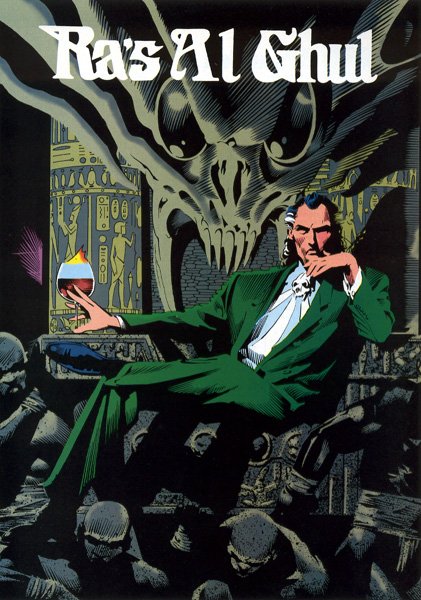
Someone obviously didn't read anything about Ra's al Ghul...

A new so-called family movie came out shortly ago, called Hoot, and it seems that the emphasis is on eco-terrorism. It's already gotten more than enough criticism (and flopped at the box office). But what's really a shame is that the scriptwriter/director of the movie, Wil Shriner,* clearly didn't ever read a thing about Ra's al Ghul, the Bat-nemesis who was quite an eco-terrorist in his time. Here's a profile of one of Batman's most craftiest foes:
Ra's's goal is a world in perfect environmental balance, a goal he will achieve at any cost. Since he believes that the best way to do so is to eliminate most of humanity, he may be regarded as an ecoterrorist bent upon global genocide. That he has the means to achieve his goal makes him extremely dangerous and brings him into frequent conflict with Batman. Ra's usually tries to assault the world's human populace with a biological weapon, such as a genetically-engineered virus.
The Hoot movie, pried from a Carl Hiaasen novel, may not go quite as far as Ra's did, but ecoterror is still ecoterror, and what a shame that these days, putting emphasis on lawbreaking is the attempted norm of the moviemakers. After all, isn't threatening people with deadly weapons, whether or not they be alligators, and kidnapping, among the many crimes Ra's specialized in? Indeed. And the director of Hoot should be ashamed of himself for promoting acts of violence in the movie almost like what Ra's did to his innocent targets years ago.

It's true that animals, even owls, have rights, but it pales in comparison with the subject of human rights. And promoting violation of human rights for the sake of animal rights, not to mention breaking the law, which superheroes wouldn't approve of, is a bad example.

More on the movie from: Okie on the Lam in LA, Three Sources, The Dragon and the Phoenix.

* Argh, why must the browser window narrow itself whenever I access that page!

Labels:

Monday, May 22, 2006

The real reason why Superman would be better than Batman

The Rushville Republican has a writer who talks about the long-running debate on if Superman is better than Batman. But, as expected, it really misses a lot of deeper points that can be made.
Superman’s hold on the world is that his existence deals with being. How do you live with your gifts? You cover them up with a dull suit, head off to an ordinary job, and wake up every day knowing that the fate of the world rests in your hands. He’s can’t help but be super--his arsenal of superpowers coast in his blood and permanently set themselves in his ways. He cannot cease to be Superman.

Batman, on the other hand, is an entirely different story. While Superman tends to be a symbol of things to strive for, Batman is a symbol of what people can become if they work really hard. He’s dark and deeply conflicted. He chose his fate as a crime-fighter, destiny did not choose him. He transformed himself into a rubber-wearing crime fighter with a cool car that gets scandalously good gas mileage, and chose to stock his basement with cool gadgets. His disguise is to hide the fact that he is ordinary, with no superpowers, and with which he covers with his souped-up doodads. With the presence or Robin, they become a crime-fighting team--although the little green underwear-wearing orphan makes Batman look like a crime-fighting baby-sitter.

According to an online poll, if you are a Superman fan, your favorite colors are bright, bold and primary. You travel alone. You revere with strength and grace. You believe in truth and justice. Your favorite gadget is--again, who needs gadgets? You think Hollywood doesn’t understand the purity of heart or the nobility of purpose. You are shallow, but sincere, and your favorite time of day is morning.

If you are a Batman fan, your favorite colors are muted, murky and muddy. You travel with a sidekick. You revere intelligence and canniness. You believe in vengeance and skullduggery. Your favorite gadget is--well, who can name them all? You think Hollywood gets it, and you are a deep and ironic person. Your favorite time of day is midnight.

So again, I ask, which is better?
You want to know, Ms. Elizabeth Gist? Okay, I'll tell you. It's not which character I'm going to argue here, it's the approach to characterization I'm going to. And until, I dunno, maybe the early 1990s, Batman had plenty of that, namely, humanity and sincerity, courtesy of stellar writers like Denny O'Neil, Steve Englehart, and Gerry Conway. But then, courtesy of the obsession with imitating Frank Miller's storyline in The Dark Knight Returns, just about every writer for about a decade started to turn Batman into a self-righteous joke of a crimefighter, saddling him with half-baked, half-hearted storylines, and then, just when Ed Brubaker tried to fix things by restoring some humanity, DC made it worse by shunning all that in favor of coming up with a persecution of their own properties in Identity Crisis, Superman included, that claimed that the reason he became such a somber mess with very little humanity, if at all, was because his very own fellow crimefighters caused it to him. And at the same time, they confused everything by showing Batman getting all worked up over what the Justice League was doing to Dr. Light, while ignoring the crime the said supervillain inflicted upon Sue Dibny.

That, IMO, is what's wrong with Batman today. It's not that his world is dark and bleak, in contrast to Superman's bright and optimistic one. It's that the characterization is way below par, and further damaged through PC tampering.

With that kind of problem at hand, is it any wonder I've bought so much more Superman books than Batman books?

In any case, I do enjoy the optimism of Superman better than the darkness of Batman. Mainly because there's so much wider a range for adventure provided, certainly in the solo books.

I'll have to disagree with the reporter though, on the notion that being Batman means having a sidekick, or that being Superman means working alone - because Bats has worked alone, and effectively, while Supes has worked on many an occasion with his teen cousin Supergirl, Kara Zor-El, she being his sidekick. Wherever anyone got the idea that Bats only works with sidekicks while Supes doesn't is beyond me.

Labels: , ,

Manga/Anime clubs in Boston

The Boston Globe talks about the manga and anime clubs in the big city, and the 2006 Anime Boston convention that's coming up.

Labels:

Third X-Men movie may not be the last

The Chicago Tribune says the third X-Men movie might not be the last one:
By the time the dust clears in the big finale of "X-Men: The Last Stand" -- and, no, we're not divulging the ending here -- fans of the movie franchise might be somewhat confused.

After three films chronicling the adventures of a band of mutant superheroes that first surfaced in comic-book form, is this, indeed, the last stand of the X-Men?

Twentieth Century Fox studio wants us to believe it is. Director Brett Ratner says it is. But in Hollywood, where decisions are largely based on box-office numbers, the door is always slightly ajar for more of a good -- if not profitable -- thing.

"Who knows?" said Hugh Jackman, who plays Logan/Wolverine in the "X-Men" films. "When we were shooting it, it was called `X-Men: 3' but the studio came up with the title of `The Last Stand.' I've been in some pretty high-level meetings where they have said that their every intention is to finish it here. However, anyone who has any kind of eye on business knows that things rarely stay that way. But there would have to be a compelling reason to do another."
I just hope the ending they're not divulging is a repeat, or a parroting, of what the old Phoenix story from 1979 was, with Jean Grey seemingly dying, until it was revealed in 1985 that it was all just an imposterous entity. In any case, what this here...
"Ultimately, some fans are going to be upset with this," Jackman said. "Some will disagree and some will love it. There are some shocks in this story. That's what we owed the fans. This is the end of a trilogy."

Supposedly. In the event that it is, it won't be the end of Wolverine.
Didn't think so. But even if not, what is it that we're going to be upset with here (or annoyed with)? Why should we be? After all, it's not the original comics we're talking about. That's what I find of concern for the moment, not the movie.

I hope Jackman isn't alluding to the "fanboy" stereotype. Because a few years ago, I think he and/or some other cast members did. And that wasn't nice.

Saturday, May 20, 2006

Getting what the Hulk is about

William Kulesa, a comics columnist for the Jersey Journal, has some difficulty understanding what the Hulk is about while reviewing one of the recent Loeb/Sale miniseries for the green goliath.
I 've never really been able to figure out most people's attraction to the Hulk. Sure, he's big, green, indestructible and in the recent "Ultimate Hulk vs. Wolverine" he ripped Logan in half, but I just never got it. What can you do with the Hulk besides smash things?
Answer: you can have him go after communist and fascist villains, as he first did during the 1960s, when the Cold War was raging on. (And from the looks of things today, it just might be coming back!) The whole fun of the Incredible Hulk to begin with was that the 7-foot tall anti-hero would find himself on the trail of all sorts of commie criminals, one who created him (Igor Drenkov) when he hoped for a chance to get Bruce Banner out of the way so he could steal his classified files (changing into the Hulk at night, Bruce went on his first Hulk rampage, heading for his living quarters where he found Drenkov trying to burglarize the house, and knocked him senseless). And of course, there was the nifty rogues gallery, one of the first being Gargoyle(?), and most certainly the Leader, whose main challenge was that he relied more on brains than on strength.
But with the names Jeph Loeb and Tim Sale on it I couldn't resist picking up "Hulk: Gray."

There is something about the team of Loeb and Sale that in my experience produces nothing but greatness. Some of my favorite comic books are those they have written which revisit the origins of some of the greatest comic book heroes in the industry and I eagerly anticipate any work they put out together.

It's easy to judge the Hulk by the vast majority of the stories that have been written about him. He is big, dumb and he smashes things, end of story. On the other hand, when in the hands of a writer capable of nuance and depth we find more to the character than ever might have been imagined. Utilizing the much maligned device of the flashback Loeb grants us insight into the Hulk and those characters that surround him. He is no longer a Jekyll and Hyde stand in and Betty Ross takes on immense psychological import. The character of the Hulk takes a back seat in "Hulk: Gray" and becomes a plot device for exploring all those that revolve around him.
Well, I wish he'd think to mention the fact that the Hulk actually did become more than we might imagine when Peter David took up the writing in 1987, after Al Milgrom left (and I just went and bought two of David's Visionaries collections last week!) That aside, what's that about the Hulk being "dumb"? Not really. He did get his intellect lowered for a time shortly after his first appearances, but over the years, he regained some of the intelligence that he lost.
To me, Hulk remains in the same category where I placed such characters as, Punisher and Ghost Rider. They make interesting sub characters in the greater comic book universe they dwell in but have little merit on their own over an extended title. Starring in mini-series which explores the depth of their extreme psyches though, we see their true colors. These characters have more to offer literature than the mayhem they may commit - it's possible that they can tell us a little something about what it means to be human.
Yeah, but there's a difference: while I can't think of anything to say about Ghost Rider, Punisher, as some have argued, is a one-trick pony because he - or the writers - leave no room for recurring adversaries: Frank Castle slays them all. For the Hulk, his own adversaries, like the Leader, for example, are just too smart to be destroyed. The Punisher's also got almost no supporting cast, if at all, whereas Bruce Banner's had plenty, whether Betty Banner, her father, Thunderbolt Ross, Rick Jones, Dr. Leonard Samson and maybe even the Avengers as well.

Labels: ,

Thursday, May 18, 2006

Oh well. Guess I'll just have to take back what I said earlier...

...about Dan Slott being an ideal choice for a Spider-Man writer. But, if he's going to go and sour even minor characters like Starfox, as he did in She-Hulk #7, by implying he'd become a rapist, to say nothing short of writing a story about Eros being accused of rape by brainwashing as a joke(!), then Slott, simply put, would have to be the last choice for writing Spidey's -- or any other Marvel character's -- adventures in the MCU. (This blog's got some scans of that issue, and no, I don't find it funny. Just depressing.)

Thinking about the back issues I've got with his appearances in the Avengers from the 1980s, I'll admit that he did seem fairly creepy at times even then, but he knew how to use his powers wisely and not for personal gain and exploitation. Here, all Slott's done is something along the lines of say, Straczynski's work on Amazing Spider-Man: he's written something that most people would be glad not to consider part of continuity any longer, and even gladder to see fade into obscurity. When Gardner Fox wrote that rare misfire of a story in The Flash in 1967 about a goofy angel-like entity called Mopee, it was nothing compared to the rising number of duds surfacing today that are so unbearable, that that's why they qualify for the name of that old character that the Comics Buyers Guide later took to using as a way of describing bad stories that people would rather forget.

Now, with this news about She-Hulk #7, I'm uncertain if I want to buy the TPBs already published of She-Hulk written by Slott. If I do, it certainly won't be because he wrote it. And yet, when I contemplate the news of The Thing's cancellation now, I can't help but wonder if, for Slott, this was but a punishment deserved.

Writers of comics, company owned or even self-owned, have to take into consideration that art is meant to encourage and inspire, and not to corrupt morale and trivialize serious issues, nor to turn them into a parody. That's practically what Kevin Costner's Robin Hood: Prince of Thieves and Mel Brooks' rip-off, Robin Hood: Men in Tights did during the early 1990s, and now, we have to put up with this garbage here too! Please.

Unless Slott can apologize and just be honest, that he erred, all I can say is that this whole Starfox story tarnishes his reputation IMO.

Update: okay, here's the link to the CBR thread on which Slott defends his take (thanx, fax). Well, okay, I appreciate his efforts, but nevertheless, I'd like to say that the whole premise is so wrongheaded IMO, because:

- It runs the gauntlet of character assasination for Starfox, and can leave a bad aftertaste.

- I would think that Jen would be representing the plaintiff, and not the defendant, in a case like this.

And the best argument I can make here is that, if it's an otherwise impossible story, it shouldn't have been written at all. It takes less effort.

Labels:

Wednesday, May 17, 2006

Ben Grimm's new solo book cancelled. Will Ms. Marvel be next?

Given the lack of faith the Quesada-dominated editorial at Marvel is still held hostage by has in the characters under their control, this doesn't surprise me at all (Via Great Curve). So much for wanting to put together a whole list of the issues as time goes by on that Ben Grimm fansite I built.

Writer Dan Slott told people at Newsarama:
THE THING launched during the beginning of INFINITE CRISES, the end of HOUSE OF M, and when a large portion of Marvel's promotional dollars were being spent to push SPIDER-MAN: THE OTHER. It was a horrible time to launch ANY book-- let alone a 5th ongoing FANTASTIC FOUR title (FANTASTIC FOUR, MK4, ULTIMATE FANTASTIC FOUR, and MARVEL ADVENTURES FANTASTIC FOUR) that was also coinciding with a couple of FANTASTIC FOUR mini-series and one-shots.
Of course it was a horrible time to launch a book like this one, but then again, why would Marvel's resident domineers really even care?

Still, with what Slott has to say about his success in developing a fanbase despite these problems, that's exactly why, as JK Parkin says, there should be a campaign to put Slott on Spider-Man. But not just Spider-Man, it's THE AMAZING SPIDER-MAN he should be on! It's thanks to the current management's keeping non-entities like Michael Straczynski on ASM that I haven't been able to buy great characters like Spidey for an epoch. (Update: and now, here's why I am so disgusted, I take back my kind words for Slott.)

Oh, like I said before, if The Thing is going down, are we to expect Ms. Marvel to sadly take the plunge soon too, even if Brian Bendis is the one writing? (Considering how questionable his devotion to the MCU is, something tells me it wouldn't matter to him, if he's getting paid well.) I don't know, but in any case, Carol Danvers deserves much better than Bendis as a writer.

Labels: ,

Monday, May 15, 2006

Now I know why I'll never buy another crossover again

In this article on Salon.Com's book section by Douglas Wolk (via Backwards City), which talks about "events" and crossovers, he says at the end:
Well, he's right, sometimes. God knows there's plenty of cynical, awful superhero products packing comics stores' clearance bins, and some of the worst offenders are "event" comics and crossovers. So why do people keep buying them? Because when they're good, their charge of fantastic invention is like nothing else -- a well-executed crossover offers a sense not only of experiencing a crucial moment in a huge, fictional history but of being able to understand the meaning of that moment by seeing it through multiple artists' (or characters') eyes. And, at their best, they give even the terrible comics that came before them meaning and value, as unreliable but irreplaceable documents of a world whose wonders are only more colorful versions of our own world's.
Well, it's a well-meaning argument, but I'd say it has partly what to do with the still prevailing addiction to comics that many readers still seem to have difficulty in shaking. Nevertheless, this shows perfectly why I won't be buying any more company wide crossovers. They're likely to be the most weakly written, and, as evidenced by Secret Wars II, they tend to be the most likely to drag down the quality of any individual book that gets caught up in the vortex. And they're exactly what anyone part of the comics audience should avoid, certainly any miniseries that connects disperses the dots.

If readers were to vote no to crossovers by not buying any of them, that would send a message to DC and Marvel that we don't approve of them, certainly not if they involve story elements as crude as those in Identity Crisis, and then crossovers would begin to decrease and fade out altogether. The same goes for "event" comics.

I therefore urge everyone - do yourselves and your wallets a favor by not getting tricked into buying a crossover/event comic miniseries, certainly not if it's in bad taste.

Labels: ,

Thank goodness someone did have the guts to say what it really is

After sloshing through countless sewer-quality articles in the mainstream press about Identity Crisis, that sugarcoated, sensationalized and pandered on and on about the whole mess, I finally found that someone gave a real, genuine opinion on it in the Boston Phoenix, and it's Douglas Wolk, who created the 52-Pickup blog. Might as well see if I can comment on it here, and give a few expansions...
Identity Crisis, now reprinted in a single hardcover volume (from DC), was a big event in mainstream comics by any standards. Written by bestselling novelist Brad Meltzer and drawn by Rags Morales and Michael Bair, it topped the comics sales charts for most of its seven-issue run last year, largely because it was presented as Really Important — its repercussions are continuing to spill out into DC Comics’ superhero titles. (It’s a predecessor to the hugely hyped Infinite Crisis, whose first issue DC released on October 12.) But this is pretty much the worst comic book ever to be so heavily promoted. Smoothly if blandly scripted, glitzily if undistinctively drawn, Identity Crisis is a gilded turd of a book, abusing its characters’ history and meaning for cheap, sordid shock value and giving nothing in return. It typifies everything that’s wrong with contemporary comics.
Amen. It's also a thinly veiled political bias, and I highly doubt that that many people would want to tune in to something that shows a cute kid vomiting after being punched in the stomach.
The plot involves a terrible secret from the Justice League of America’s past that comes to light in the wake of the shocking murder of Sue Dibny. What’s that? You don’t know who Sue Dibny is? Why, she’s the beloved wife of the Elongated Man! The wisecracking down-to-earth soul of Justice League Europe in the ’80s! . . .

Still confused? If you haven’t already read hundreds of mediocre superhero comics, Sue’s death will have no emotional resonance for you. If you have, seeing her raped and murdered is at best a gross misuse of everything that was interesting about the character. Identity Crisis is almost incomprehensible to readers who aren’t already intimate with its dozens of characters and their relationships.
And enough to make one want to join Zatanna on the floor belching. That said, what's good about this article here is that this is the right way to explain things as they should be to people not familiar with comics, who do read mainstream papers, even if there's still more that could be told about, such as the way the writer of the book seems more interested in how the heroes brainwash Dr. Light, yet no interest if at all in Sue herself and the question of if Dr. Light was asking for punishment because of his crime. Although, the part about the brainwash is alluded to here:
Even so, it might work as an adventure story if its plot weren’t riddled with implausibilities. Among other things, you’re asked to believe that a grotesquely out-of-shape man who’s just been shot, fatally, three times in the chest can still throw a razor-edged boomerang hard enough to pierce his assailant’s heart; that a one-eyed man with a sword can stab someone who moves at the speed of light; and that a happy-go-lucky supporting character of 40 years’ standing can turn into a psychotic serial killer without anyone’s noticing. And the entire story hinges on the idea that its heroes have secretly acted nastily and venally, in their own interest, and covered it up, again and again, for years.

It’s possible to make a great story by bringing out a familiar character’s dark side as long as you seem to be raising the stakes rather than changing the rules. But Meltzer’s story is just a mess. There’s no pleasure in it, no sense of adventure or triumph or fun — only violence, betrayal, and witless flailing. It’s relentlessly grim and melodramatic, from Superman’s shedding a tear on the original cover of the first issue to the dribbling pathos of its ending.
Yep, that's the problem with it. It's joyless, crude to the core, and more interested in cruelty than anything else.
Near the end, Meltzer quotes Arthur Miller: "An era can be said to end when its basic illusions are exhausted." His intention here seems to hammer the final coffin nails (or razor-sharp boomerangs) into the Silver Age of superhero comics, the era when troubled and flawed characters could nonetheless be relied upon to do right in a crisis, when making characters believable and consistent counted for more than horrifying jolts. But what Identity Crisis is presenting as exhausted illusions are the idea of heroism itself — the ethical compass that orients superhero comics — and the notion that major comics stories should speak to an audience greater than long-devoted fanatics. Without those principles, the superhero genre is itself exhausted of everything but an endless loop of brightly colored brutality.
Which brings us to a most interesting question: did DC ever actually intend to even so much as whisper to a wider audience? Seeing how none of this hype about newcomers to comics seemed to revolve around Infinite Crisis, I think that puts the lie to any claims that newcomers were picking up Identity Crisis in droves, and shows that in truth, the majority of buyers were really only the veteran audience.

Although it's possible that, any newcomers who were stung by this trash may have abandoned it in such large quantites, left with a really bad impression of what comics are all about, that in the end, not many were left to give Infinite Crisis as big an audience.

Labels: , ,

Sunday, May 14, 2006

FCBD in Boston

The Boston Globe writes about the Free Comic Book Day that took place in the big city today.

Thursday, May 11, 2006

...And I'm no longer a fan of Geoff Johns

Infinite Crisis #7 made its debut this week, and reading reviews like this one from Comics Should be Good certainly sums up some of how I feel about him, certainly now. Yes, he's a hack, and he certainly descended into being one. Or, put another way, he prostrated himself to the editors' will.

When he first began his career in comics back in 1999, I will say in fairness that some of his stuff was pretty good. And while the violence he put into the scripts in the Flash was disturbing, taken with a grain of salt, the first half of his run there was good. It was in the latter half on that title that he began to self-destruct, as supporting characters like the police officers Fred Chyre and Jared Morillo were slowly but surely phased out of use, till they became almost entirely irrelevant. But what really irritates me is that...what was the whole point in putting Wally and Linda through all that neo-Reverse-Flash nonsense for at least a year before getting a much more satisfying ending? Did we have to go through with all that? Exactly why, when I thought it over, I felt so annoyed that I sold off the issues I had from the latter part of Johns' run (only two are left). He's got no real sense of characterization or development, and seems to have used the Zoom story as an excuse to cover for that.

There have been some arguments lately, some justified, that too much attention is being given to the villains in movies and comics, and in the pages of the Flash, Johns did admittedly seem to be heaping more attention upon the crooks than the heroes. But while it may be possible to root for ones like Captain Cold, what's interesting about his take on the Rogues' Gallery is that, he first built up sympathy for some of the villains, then later on, he destroyed it. With the new Mirror Master and certainly Zoom, this was actually a good thing to have happened, since how exactly can one sympathise with one who targets someone else's wife, and another who's a hired gun? But when it came to Captain Cold, I did not appreciate it when this was done at all.

And while I never read the old storylines of "Heatwave Plays it Cool!" and "Heatwave's Blaze of Glory!" from 1978, I highly doubt they were as creepy as what Johns prepared for Mick Rory last year, when he depicted him as something akin to a born vandal (hence, that issue was among those I decided to sell off). And if I'm not mistaken, Johns actually managed to confuse logic when he showed Mick wearing winter coats on his way to school! The part about his being locked in the freezer by a bully was told about after that part, making for some incredible confusion.

On JSA, the first title he wrote regularly, with David Goyer, he did well at first, but then, as of last year, he stopped writing stories that were enjoyable, prostrating himself almost entirely to what grew out of Identity Crisis.

Hawkman was probably his strongest work, and I figure it's a good thing that he left after 25 issues. Yet that he went along with the implications that IC made against Carter Hall implies that he didn't care that a character he presumably likes was being cheapened.

Teen Titans suffers due to the fact that it seems to have been launched in Young Justice's stead as part of all the plans to do Identity/Infinite. I do own the first three TPBs of this, but seeing that the fourth one contains the issues with Dr. Light in his revealed-as-rapist mode, I won't be getting that.

As for Green Lantern? Well, it's great to have Hal Jordan back, but with the way that Johns descended into such catastrophe by now, it's going to be very hard deciding if I should get it.

It's a good thing I haven't read Infinite Crisis, because, judging from some of the dialogue offered in the synopses, it's apparent that there's some kind of attack going on against Superman, right down to making the Golden Age Man of Steel a baddie, and later killing him off in bloody fashion. And any part about Earth-2? Abandoned as quickly as it came. Whatever this miniseries is trying to retcon (at face value?), it's apparent that it won't last long, yet it wouldn't surprise me if Johns himself isn't asking anyone to accept it either. He's clearly ruined his credibility as a writer deliberately, doing things that noone asked for, and now that he's ascended the rank of an editor, why should he really care?

So I'm no longer a fan of Geoff Johns, because it's apparent that he's no different from a lot of other hack writers with questionable devotion and dedication to comics and what makes them work today.

Labels: , , ,

Meltzer doesn't like J'onn J'onzz. One more reason I don't look forward to his JLA

Well, it looks like I'm not alone in feeling that DC's hiring Brad Meltzer to write about 12 issues of the JLA relaunch is a slap in the face to anyone with common sense. At Mountain of Judgement, Cole Moore Odell writes a good argument about why it's just not a good thing:
With the announcement of Meltzer's JLA #0 on the July schedule, the Identity Crisis debates are bound to start up again. The new book's promo copy says that "Meltzer broke the JLA down in the top-selling, critically acclaimed Identity Crisis - and now he puts all the pieces back together again!" So I don't expect any--or at least not much--fin-headed satellite super-rape at 23,000 miles above sea level this go-around. But this is still Meltzer, who has shown himself to be a godawful superhero writer whose instincts with these characters, supposedly born of sincere love of the JLA of his 1970's childhood, have been wrong at almost every turn. And whose comics--Identity Crisis and a boring, underdeveloped arc of Green Arrow--fail to rise above the overheated melodrama and contrivances of the worst fan fiction.
Exactly. Even if there's no overwrought, excessive elements like rape tossed into the pit, that doesn't mean that the coast is clear. I wouldn't be surprised if he seizes upon every or any opportunity possible to slip in an irritating political bias, allegory, or allusion.

And while his success with Green Arrow is probably a matter of opinion, here's what I think might make the best theory on how he was able to reach the position he did: Dan DiDio found the perfect Trojan Horse. Meltzer probably knew that to fool everyone, he'd need to be clever, and, voila, he won over those with a favorable opinion on his Archer's Quest arc, enabling him to then stab the readers in the back by foisting Identity Crisis upon us.
For me, the worst thing about Meltzer is the pretension to seriousness, to real-world dilemmas and ethical concerns. The DC hype for Identity Crisis was all about its unflinching exploration of the "real" consequences of superheroism--how putting on the cape would put your loved ones at serious risk of violence. But again, it was all a con. The only DC characters at any risk are those without valuable Warner Brothers licensing opportunities. Sue Dibny can die, not because of anything her husband the Elongated Man may or may not do, but simply because Sue Dibny will never be a cartoon star, and will never be used to sell peanut butter or bike horns. Lois Lane isn't going anywhere, even if Superman told every villain in the world he loved her and handed out directions to her apartment. Therefore all the talk of "realism", of clear-eyed looks at superheroes like they're cops or firefighters, is really just a baldfaced lie--a lie Meltzer and Didio eagerly told in order to sell comics to a segment of aging fans who like the idea of their superheroes "growing up" but who apparently don't understand the extratextual reasons why they never really can.
But I can. And it's that, thanks to the fact that quite a few aging fans, who seem to confuse reading material with chocalate ice cream, comics end up becoming horrific as Identity Crisis, because the aging fans are terrified(!) of the thought that, if they don't keep on buying day after week after month, their favorite comics will be canceled, never to be seen again. With people like those among the readership, I'm almost ashamed to be one of my own species. Hell, in past months, I decided that I did not need the latter half of Geoff Johns' Flash run, and sold/traded off the issues I had to make room for any better stuff I could find (as of now, I've got only two issues left from the latter end of his run, post Flash #191).

And Odell is right, Lois Lane and others of her ranking will never be terminated, because their legendary status grants them diplomatic immunity. Personally, I would think that to allow for old-timers like Jay Garrick and Alan Scott, the first Flash and Green Lantern, respectively, to pass on, albeit quietly and not in a company-wide crossover, would be a good idea, and allow for some development. But to date, it seems unlikely, despite the fact that they haven't exactly been big characters in ages.

As for Meltzer, Title Undetermined found that in a recent issue of Wizard, awful magazine they are, he told them the following about Martian Manhunter:
"Believe it or not, [J'onn] has not always been my guy. I don't see him as the center point of the League."
And in saying that, he puts his credibility as a comics fan further in doubt. In fact, about a year ago, a comics reviewer for another site told me that the reason why Meltzer was allowed to kill off Captain Boomerang was because Geoff Johns gave him permission, as he disliked the character.

That seems to be a notable problem with some writers today, including Brian Michael Bendis (who said that he didn't like Hawkeye and Scarlet Witch) when he wrote Avengers: Disassembled: They're selfishly claiming the right to killing off characters based only on their personal opinion of a character, which totally violates Mark Gruenwald's famous argument, "Every character is someone else's favorite. You shouldn't just kill them off, or worse, ruin their appearances in retrospect." And much as I dislike Gambit, I'll have to admit that they shouldn't have done that to him either (his letting Mr. Sinister know the location of the Morlocks), even if by now, it's been dropped.

Labels: , ,

Wednesday, May 10, 2006

Conservatives are being all but kept out of comics

And if they are, that could be one of the reasons why they're failing. Reading what another blogger I know has to say on Adam's Blog, I'm in agreement that comics are indeed in a sorry state due to how close-minded the head honchos have become as well. And it's a shame, because, as he says:
If you want someone to tell you how old and powerful comics are with a lot of big words, I'll direct you to Scott McCloud's "Understanding Comics", which is an excellent read even if you're not a fan of comics. McCloud has a lot to say about comics and visual arts in general, and though I have no idea what his politics are, he's a recognized authority on the subject. (Insofar as comic books have recognized authorities.) If you don't want to go buy Scott's book, or visit his website at Scott McCloud.com then I'll simply ask you to take it as read that comics are an old, powerful, and important artform, and move on.
Not to worry, I'm in full agreement that McCloud is one of the best experts on the subject, and, now that I recall, the historian Mike Benton was too. And comics are most definately a powerful medium, one that, as I've thought in recent years, is probably the only medium that I want to really uphold. Not movies and television, just comics.
Honestly, I don't know how much of an inroad can be made into the mainstream titles -- if ... you can picture chain link fence keeping conservatives out of Hollywood, then picture DC, Image, and Marvel on an island somewhere in shark-infested waters, surrounded by a twenty-foot high concrete wall topped with razor wire. (Granted, it's not easy for anyone, but it's doubly hard for conservatives, at least if they want their writing to reflect their own vision, rather than someone else's.) Still, the talent is out there, and talent always eventually finds a way to break out.
There's a point to this - Chuck Dixon, who is conservative, seems to have been all but shut out by DC and Marvel due to his standings, I don't know. If he was, that's certainly a shame (I will have to note though that, if he was among the writers who decided to imitate Frank Miller's Dark Knight, effectively damaging Bruce Wayne as a character for at least a decade, then that's one part where I'll have to express my disappointment in Dixon).

Comics may not suffer from the same kind of PC madness that the movie industry does, that seems to bar a lot of conservatives from being allowed to have their say and viewpoint, but if the big two don't make the entrance to their companies more friendly for conservatives, they won't be doing themselves any more a favor than the movie biz is.

Labels:

Tom Cruise lined up for role in Iron Man movie...too late

Seems that Tom Cruise has been selected as part of a lineup for something I'd heard being discussed a few years ago: the role of Tony Stark, Iron Man:
Tom Cruise is being lined up to star in superhero movie 'Iron Man'.

The 'Mission: Impossible III' star is wanted by film bosses to play billionaire
industrialist, Anthony Stark, who fights crime in a super-powered suit.

Cruise, who is engaged to Katie Holmes, has already expressed an interest in the role. In 2004, the actor admitted he would be prepared to take the part if "he got a good script".

Jon Favreau - who made 'Swingers' and 'Elf' - has already been signed up to direct the film, the latest Marvel comic book hero to be brought to life on the big screen.

Cruise is not the first actor to be linked to the role, 'Face Off' star Nicolas Cage and 'Titanic' actor Leonardo DiCaprio have both been tipped in the past.

Movie bosses and Marvel Comics chiefs have had an 'Iron Man' movie in the pipeline for several years and had originally hoped to have the movie made and released in the summer of 2004.
Unfortunately, judging from his Scientology background and how it affected the box office grosses for his latest movie, Mission: Impossible III, I'd say that'd be a bad idea. Please, no Tom Cruise.

Labels: ,

Thursday, May 04, 2006

Star Trek patents are edging towards fact

From National Geographic, we have the latest news on how some ideas we've seen in sci-fi favorites like Star Trek might now be reaching reality (H/T: Ace of Spades):
Warp drives may be the stuff of science fiction, but another Star Trek staple appears to be edging toward science fact.

The energy source that enables the starship Enterprise to boldly go where no one has gone before has, according to one controversial new claim, moved much closer to reality.

A New Mexico company has just completed its initial studies of an antimatter-powered rocket that it hopes will someday take astronauts to Mars in 90 days or less.

[...]

In the 1950s Austrian engineer Eugen Sänger first suggested using positron-electron annihilations to power spacecraft. But one of the chief problems that dogged his efforts was storage.

[...]

Positronics' researchers base their novel antimatter rocket design on published studies that an electrically neutral positron atom could be artificially held together for at least several years.

The atoms, called positronium, consist of an electron and positron orbiting each other. Normally positronium can exist for only fractions of a millisecond before the two mirror particles annihilate each other.

However, in a series of papers published in the journals Physical Review Letters and Physical Review in 1997 and 1998, a team of German and U.S. theorists calculated that the right combination of electric and magnetic fields would stretch out the positronium like a barbell and greatly reduce the probability of the electrons and positrons annihilating.

"We've done the calculations," Smith said. "And it's not uncommon to find that the lifetime [of the enhanced positronium] is [practically] infinite."
And not just anti-matter matters might be on their way - even cloaking devices!
The cloaking devices that are used to render spacecraft invisible in Star Trek might just work in reality, two mathematicians have claimed.

They have outlined their concept in a research paper published in one of the UK Royal Society's scientific journals.

Nicolae Nicorovici and Graeme Milton propose that placing certain objects close to a material called a superlens could make them appear to vanish.

It would rely on an effect known as "anomalous localised resonance".

However, the authors have so far only done the maths to verify that the concept could work. Building such a device would undoubtedly pose a significant challenge.

[...]

The phenomenon is analogous to a tuning fork (which rings with a single sound frequency) being placed next to a wine glass. The wine glass will start to ring with the same frequency; it resonates.

The cloaking effect would exploit a resonance with light waves rather than sound waves.

The concept is at such a primitive stage that scientists are talking only at the moment of being able to cloak particles of dust - not spaceships.

In this example, an illuminated speck of dust would scatter light at frequencies that induce a strong, finely tuned resonance in a cloaking material placed very close by.

The resonance effectively cancels out the light bouncing off the speck of dust, rendering the dust particle invisible.

One way to construct a cloaking device is to use a superlens, made of recently discovered materials that force light to behave in unusual ways.
It's incredible, but it looks like what we first thought to be just the stuff of science fiction is now becoming real, just like space travel as in Jules Verne's own From Earth to Moon eventually did.

Now how many comic book staples will soon be on their way to the real world...

Labels:

Trailer for Superman Returns

The trailer for the upcoming Superman Returns is now online (via Hot Air and Ace of Spades).

(There's another one here).

With any luck, there'll be a new generation of artists soon

The Asbury Park Press writes about an artist in New Jersey who's giving children in Little Egg Harbor lessons in artistry.

Tuesday, May 02, 2006

MacPherson just plain misses the points

Here's something by one of The Fourth Rail's two webmasters, Don MacPherson (Randy Lander all but quit a few months ago), that he wrote back in 2001, but which, as I discovered, had apparently been erased from the website since then, so I had to go and find it in Archive.Org instead. He may have had a point that comics in the 1990s (from Image, if anywhere) were valueing style over substance, but beyond that, he only makes me realize as to why I wouldn't dare push too far in the opposite direction, as he seemed to be advocating very unclearly when he first wrote this.
The comic-book industry has gone through some rough times in the last few years, and it's universally accepted (or at least, it should be) that it's been suffering through a depression of its own design.

In the early 1990s, there were big bucks to be made in comics thanks to the speculator boom. "Hot" artists -- McFarlane, Lee, Liefeld -- emerged, and people were snapping up their books. And not just one each. Two copies. Five. Twenty.

Their earlier work was hard to come by, and back-issue prices rose. For some reason, thousands of people were convinced their newer stuff -- with literally millions of copies available -- would be equally in demand in the long term.

We know they were wrong. The fallout was far more devastating than the speculator boom was advantageous. It saw reams of trash thrust onto the shelves of comic-book stores, and it took the industry years to bounce back creatively.
It's been five years since MacPherson wrote this, and to be honest, I think that's all a matter of opinion. Because, what have we had in the time he wrote this? We've had five years of J. Michael Straczynski writing Amazing Spider-Man and not really accomplishing anything, and sinking deeper into mediocrity and downright angering, as was the case with "Sins Past", which did little more than to desecrate a the memory of Peter Parker's first true love, Gwen Stacy. And, there was also the degradation of Captain America, the not-so-impressive IMO run by Grant Morrison on X-Men (and Chuck Austen's run was just as crappy), which struck me as um...gross, and even the Avengers were exploited for politically motivated storylines with editorial interference glaringly apparent. Then, in 2004, they pulled Avengers: Disassembled on the audience, bouncing back to company wide crossovers and leading up to House of M, which seemed like an attempt to do something they'd actually been doing quite a bit in the past few years - alternate universes and allusions to their own What If...? anthology. And it may not even end there, what with Decimation now on the horizon.

That's what Marvel did wrong. But lest we think DC is any better, in 2004 they proved they could stoop just as low, possibly worse, when they published Identity Crisis, and kept boomeranging back to company wide crossovers, with the nadir surely having to be the way they spread the "repercussions" from their overblown dud throughout quite a few books the following year, all this leading up to Infinite Crisis, and now, it seems that, with the publication of Infinite Crisis Aftermath, even that x-over may not end for who knows how long.

Bouncing back creatively my foot.
It's now 2001, and the past year has seen interest in comics slowly rise. Ultimate Spider-Man was selling for $20 within a couple of weeks of its initial release. Kevin Smith's Green Arrow has gone to a fourth printing. Retailers were pre-selling Wolverine: The Origin on eBay before it found its way into stores.

Are we seeing the beginnings of a new speculator boom?
Or perhaps more of the same? That miniseries of Wolverine ripped off the readers, who were hoping for a real presentation of Logan's origin. Instead, it just ended with the signal that Marvel wanted no more than to fleece the audience of more money with more miniseries (as of now, there seems to be another mini for Wolverine on the market. I doubt it'll be any better.
...it's unlike the one we saw a decade ago. No one seems as obsessed with the artists emphasizing style over storytelling anymore. McFarlane is approving toy designs. Jim Lee is doing covers for one week of DC's Joker: The Last Laugh crossover event. Rob Liefeld is soliciting comics that rarely actually make their way to store shelves.

This time, people seem to be interested in writers. In stories. Bendis is the superstar now, not for his art, but for his scripts. With Grant Morrison on New X-Men, we see one of the industry's most experimental super-hero writers tackling Marvel's prize trophy, once closely guarded by editors with more influence on plot direction and characterization than those actually credited with the writing.
Again, it's been five years since this journalist from Canada wrote this piece, and from the way that Bendis' books were bought, I'm skeptical of their being bought for the stories, any more than they are for the writer himself (and Bendis is the one who started the whole problem of padding out books for trade paperback publishing).
Comics are in the news more today as well. The telling of Wolverine's origin made headlines in papers throughout North America. Last year's announcement that Stan Lee would be writing for DC Comics turned up all over the mainstream media. By May 2002, Tobey Maguire will be known forever as "the kid in the Spider-Man movie."
Yeah, right. Just because they're in the news, that's wonderful, bar none. Ahem. It takes more than just being in the news to be impressive. There has to be substance, and a genuine willingness to tell the audience in depth what the book is like, and if it's any good, plus offer enough details to allow the audience to determine if it's as good as it sounds. If they don't, nor have they any ability to distinguish between good and bad elements, then all they're doing is to imply loyalty unto the publishers, and not the audience.
Though there are still a lot of subpar comics out there today, the industry has reached a creative high point, and there's no sign that it's going to stop anytime soon. The timing of this winter's The Dark Knight Strikes Back mini-series from DC couldn't be better, as there's a better chance that those who loved The Dark Knight Returns but drifted away from comics might actually learn of its existence.
And beyond that, what might they have thought? Not only was it late in going to press, but it wasn't all that good either. MacPherson was really going a long way in assuming things.

And when he says the following at the end...
No, this potential boom won't be like the one before. This time, there's a chance that outsiders drawn into comics might actually read the stories. This time, there's a chance comics might actually retain some of those outside readers who peek in.

If that's to happen, though, we need to put our best foot forward. Rogue can't be thrusting her hips or breasts on the cover of X-Treme X-Men. Retailers need to direct buyers to Judd Winick's Barry Ween, not his Green Lantern. The notion of graphic novels has to include Morning Dragons, Couscous Express and A Complete Lowlife, not just trade-paperback reprints of Sandman.
...it only gives tells that he misses the point of what comics like what Rogue appears in were meant for to begin with, even if X-Treme was mediocre: entertainment and fun. Not to mention that it's always possible to write up comics that don't put a big emphasis on what MacPherson seems to despise, but we shouldn't have to force this view upon comics where nobody thought it wrong to feature T&A to begin with. Besides, Marvel and DC have long had that kind of stuff for many years, and noone complained, because that's what they read 'em for.

The main problem with the viewpoint MacPherson is espousing here is that: comics should be dead serious in order to be taken seriously. And by serious, one would have to wonder if what he means is vile little roaches like Identity Crisis #2, which he pretty much gushed over. In other words, they should be distastefully violent, make sex look revolting, and make the heroes out to look bad. And in his review of IC #3, he insulted my intelligence by making it seem as if misogyny was excusable:
If the murder that served as the catalyst for this story irked you and struck you as misogynist, then the last few pages of this third issue are going to drive you nuts. I have to admit, though, that it seems odd that Meltzer didn't opt to target a different sort of character.
Uh oh. When looking at this more closely, it sounds more to me like he was downplaying the fact that misogyny is wrong, or dismissing it entirely. To say the least, it's the part where he says, "I have to admit though..." that puts a frown of suspicion upon my face. I could be mistaken, but, there's something about that part I just don't like. Creepy.

I guess I shouldn't be too surprised by all this though. There are quite a few people of MacPherson's journalism-influenced standing who don't seem to have any idea what they stand for, nor do they seem to realize what kind of damage they risk inflicting on the entertainment value of comic books. And which is one more reason why people of his standing just aren't fit to be reviewing - because they don't seem to understand that these industry emperors wear no clothes.

Update: while we're on the subject of the 4th Rail: while Randy Lander of the same site once panned the "Identity Crisis" miniseries and even "Avengers: Disassembled," it would've been much easier to appreciate had it not been for his needless attack on the war in Iraq about two years ago:
"The Iraqis did not destroy the World Trade Center. Most of the hijackers were Saudi. This runs contrary to what 70% of the people in my country believe, according to some polls. I am boggled at the stupidity of my countrymen and women, and saddened at how easily they have been led by a manipulative regime and a corporate-controlled media."
Oh dear. While he's certainly entitled to an opinion, he is not going about things the right way by saying that his countrymen and women are stupid. And does one need to point out that the "corporate-controlled media" he speaks of is not necassarily under the control of the government, but rather, the PC-advocating establishment?

Lander's argument obscures more than a considerable amount here, including that last year, signs of WMDs being concealed that included even sarin and mustard gas began to turn up, though of course, did the opposition to the war in Iraq even care? Nope. Either way, I personally find it hard to comprehend why he'd take offense at something like IC and AD when the former comic book certainly takes a position that he for one might also happen to harbor, which is none other than an arbitrary anti-war stance.

Labels: , , ,

Flag Counter


track people
webpage logs
Flag Counter